As Malcolm and I walked past Osborne's Pond this morning, our attention was drawn to a family of Canada Geese - two adults and two youngsters. Looking rather distressed and honking loudly, it soon became clear what was causing them all this anguish. Two more of their young goslings were trapped behind a chain-link fencing across the other side of the road and unable to find a way through to get back to the water and their parents. So, we set about herding them along the line of the fence to the end, where there was a gap big enough to allow them to escape. Thankfully, they cooperated with us and they were soon scampering across the road and down the bank to be greeted by their obviously delighted parents. A happy ending and our good deed done for the day.
More youngsters have been seen lately at 'Swan Lake'. Firstly, the Coot chicks which have survived their parents' infanticide tendencies and are now almost full grown.
Even now, the parents are very rough with their youngsters, but now, they are large enough to withstand these attacks.
Far more careful with their parenting duties, the Mallards have also managed to raise several youngsters almost to adulthood. One mother in particular has successfully brought up six babies.
We saw this happy family a few weeks ago when the youngsters were much smaller, but they are now looking hale and hearty and their mother is still looking proud of herself - as indeed she should be.
One more picture of these wonderful little birds...
Welcome to my blog. Don't expect anything too high-tech or flashy, this is simply a 'diary' to share some of my photos, thoughts and observations - with a particular bias towards the natural world and the countryside around my home.
Tuesday, 5 July 2016
Sunday, 3 July 2016
Water
The great British Summer has lived down to its reputation and the wet, cool weather continues to dog our walks through Shipley Country Park. With all the rain however, the overflow from Shipley Lake into the smaller, neighbouring lake has been flushing through very nicely. The sound of rushing water is always nice, so I thought I would take a short video if it...
Tuesday, 28 June 2016
Poison
We think of carrots as being good for us, as indeed they are. But there are a few members of the carrot family which are very definitely to be avoided if you wish to maintain your good health. Among the worst offenders in this respect is to be found growing wild around the lakes of Straw's Bridge. I refer of course, to the Hemlock (Conium maculatum).
The wild members of the British carrot family can often look pretty similar to one another. Most have feathery leaves and flat-topped heads of small, white flowers. But the Hemlock is easily distinguished from it's close cousins, by the markings on its stems. Hollow and tall, the stems are usually spotted and blotched with reddish, purple markings.
The name 'Conium' comes from the Greek word 'konas', meaning 'whirl' and relates to the dizziness and vertigo-like symptoms which come from ingesting the plant. The plant is so poisonous, that even a small amount can result in respiratory failure, paralysis and death. How much is a 'small amount'? Well, as few as six fresh leaves or an even smaller amount of seeds or crushed root, may be fatal.
Such a beautiful plant to look at and a welcome sight in the countryside around here. But beware!!!
The wild members of the British carrot family can often look pretty similar to one another. Most have feathery leaves and flat-topped heads of small, white flowers. But the Hemlock is easily distinguished from it's close cousins, by the markings on its stems. Hollow and tall, the stems are usually spotted and blotched with reddish, purple markings.
The name 'Conium' comes from the Greek word 'konas', meaning 'whirl' and relates to the dizziness and vertigo-like symptoms which come from ingesting the plant. The plant is so poisonous, that even a small amount can result in respiratory failure, paralysis and death. How much is a 'small amount'? Well, as few as six fresh leaves or an even smaller amount of seeds or crushed root, may be fatal.
Such a beautiful plant to look at and a welcome sight in the countryside around here. But beware!!!
Thursday, 23 June 2016
Bee Orchids
Thankfully, we have avoided the terrible storms which have battered the south east over night, but it remains humid, sticky and unpleasant (for me anyway). So to make things feel a bit better I thought we'd have a couple of pictures of the wonderful little Bee Orchids which are flowering bravely at the moment.
It's usually tricky to spot them growing among the grasses, vetches and clovers, but this year, all of the Bee Orchids' neighbours seem to be much taller than normal, making spotting them even more difficult. But once you get your eye in, the rewards are well worth it.
Walking around Shipley Hill and the surrounding countryside yesterday, we were delighted to come across a large number of Meadow Cranesbill plants struggling to be seen among the grasses.
Such a vivid blue colour is not common in the British countryside, making them all the more special when you do find them. All these flowers at least seem to be enjoying the humid weather - more than me anyway!
Tuesday, 21 June 2016
Bugs and Beasts
The sun was shining this morning. Well, it makes a change! So, with the warmth and humidity building, we set out for a walk around Shipley Park to Osborne's Pond and round Shipley Lake. As always when the sun shines at this time of year, we were pestered by the unwelcome attentions of numerous Cleg Flies (Haematopota pluvialis). Kept busy swatting them before they could take a bite out of us, I was as always, impressed by the iridescence of their eyes and I managed to bring one of the little blighters home to take a close-up picture.
I set this stunned fly on the door handle and pointed my camera at it - much to Malcolm's amazement and disgust. But with eyes like these, why wouldn't you find them interesting?
Here is a much closer view of the picture above in which, it is possible to see the 'business end' of the fly, namely the stabbing mouth parts which cause so much pain when they bite.
As I was taking the pictures of the Cleg-fly, my attention was caught by another mini-beast on the patio. Not recognising it, I rushed out and picked it up to try to take it's picture and identify it. Like the Cleg-fly above, this insect had piercing mouth-parts too. This time, there was no danger of it biting me as the bug turned out to be Capsus ater a common capsid bug which feeds on sap from plant stems rather than blood from my hand. Another new 'tick' for the life list!
I set this stunned fly on the door handle and pointed my camera at it - much to Malcolm's amazement and disgust. But with eyes like these, why wouldn't you find them interesting?
Here is a much closer view of the picture above in which, it is possible to see the 'business end' of the fly, namely the stabbing mouth parts which cause so much pain when they bite.
As I was taking the pictures of the Cleg-fly, my attention was caught by another mini-beast on the patio. Not recognising it, I rushed out and picked it up to try to take it's picture and identify it. Like the Cleg-fly above, this insect had piercing mouth-parts too. This time, there was no danger of it biting me as the bug turned out to be Capsus ater a common capsid bug which feeds on sap from plant stems rather than blood from my hand. Another new 'tick' for the life list!
Monday, 20 June 2016
All White
The weather remains wet and miserable. We certainly seem to have had more than our fair share of rain over the last week or so and Malcolm and I are once again 'grounded' this morning. So I thought we'd have a look at a couple of pictures from our walks on drier days.
As usual in early summer, the highways and byways are decorated with white flowers of all kinds. Among the more common are those belonging to the Cow Parsley (Anthriscus sylvestris).
Clouds of frothy, white umbels were swaying in the breeze on the side of Shipley Hill a few days ago - before the rain set in. These common wild flowers have become very popular as garden plants over recent years and it's not difficult to see why. They are extremely popular with the insects too.
Another common summer flower is the Guelder-rose (Viburnum opulus).
This shrub grows to about 12 feet high if given the chance, the flowers are produced not in umbels like the Cow Parsley, but in Corymbs, which is a fancy name for a flat-topped panicle. So that's clear! Whatever they are called, the flower heads are quite beautiful.
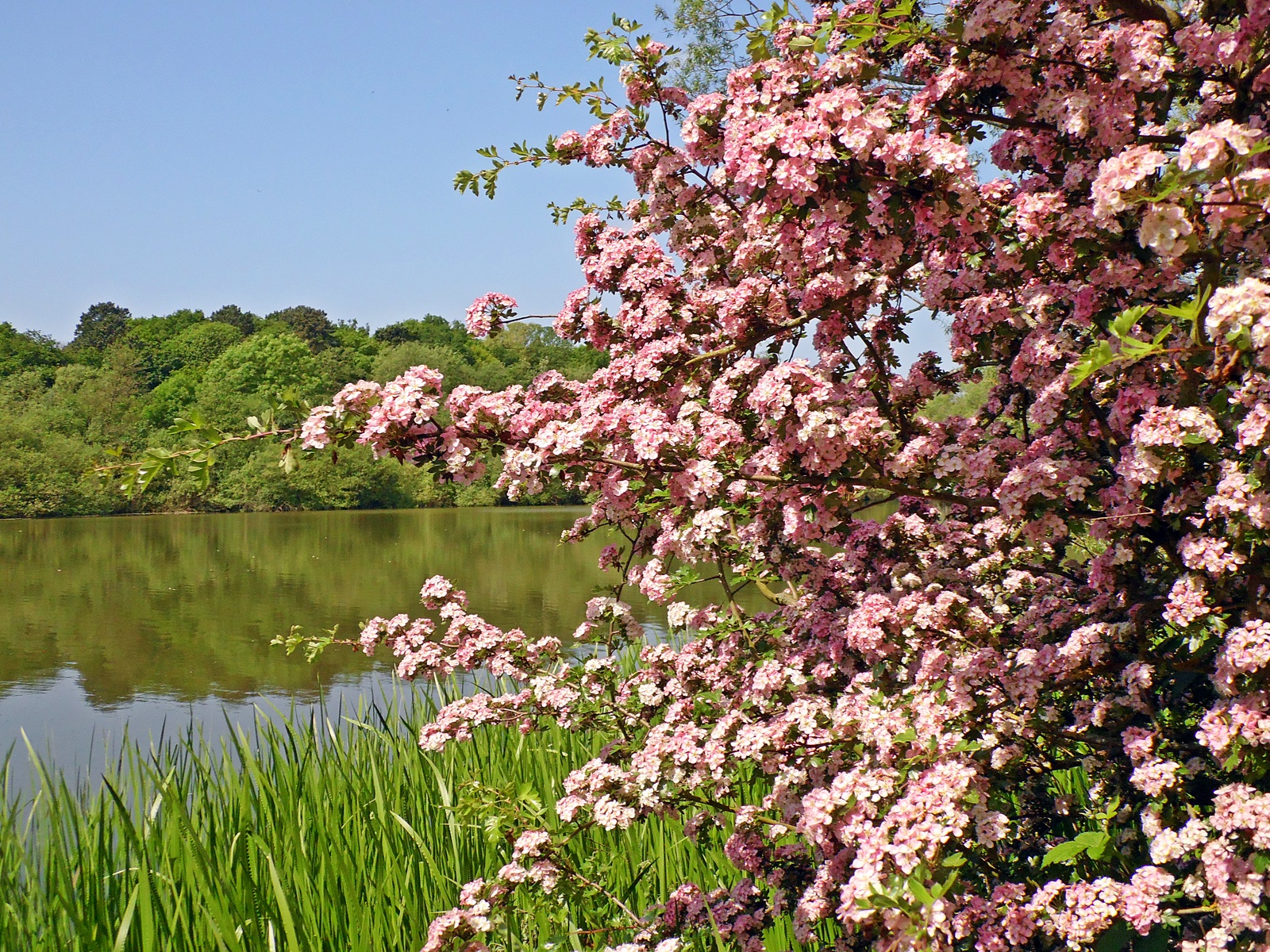
Lastly for today, some pictures of the white flowers of the Hawthorn (Crataegus monogyna).
A member of the rose family, the strong scent of thousands of Hawthorn flowers fills the air when the sun shines on them.
As the flowers age, they can turn from milky-white to pale pink before the petals fall. At every stage, they look spectacular.
That's it. Now we just need this rain to stop so we can get out again and see what's left of the flowers of early summer.
As usual in early summer, the highways and byways are decorated with white flowers of all kinds. Among the more common are those belonging to the Cow Parsley (Anthriscus sylvestris).
Clouds of frothy, white umbels were swaying in the breeze on the side of Shipley Hill a few days ago - before the rain set in. These common wild flowers have become very popular as garden plants over recent years and it's not difficult to see why. They are extremely popular with the insects too.
Another common summer flower is the Guelder-rose (Viburnum opulus).
This shrub grows to about 12 feet high if given the chance, the flowers are produced not in umbels like the Cow Parsley, but in Corymbs, which is a fancy name for a flat-topped panicle. So that's clear! Whatever they are called, the flower heads are quite beautiful.
Lastly for today, some pictures of the white flowers of the Hawthorn (Crataegus monogyna).
A member of the rose family, the strong scent of thousands of Hawthorn flowers fills the air when the sun shines on them.
As the flowers age, they can turn from milky-white to pale pink before the petals fall. At every stage, they look spectacular.
That's it. Now we just need this rain to stop so we can get out again and see what's left of the flowers of early summer.
Wednesday, 15 June 2016
On The Edge
Yesterday, despite the weather, Malcolm and I had a trip out with his mother and her friend June who is staying with her for a few days. The forecast wasn't good, but we took the bull by the horns and went for a stroll on Froggatt Edge. On the way, we optimistically looked at the horizon and convinced ourselves that it was brightening up. But once on the edge, the mist and drizzle took away the usually dramatic views.
Looking along the gritstone escarpment, at least it wasn't pouring down, but it was rather wet under foot.
Down there somewhere is the village of Curbar and the river Derwent, but it was difficult to see either through the murk.
Soon, we headed back to the car and headed for the Peak Village shopping centre at Rowsley before ending up at Belper to have lunch. Not a bad day all things considered.
Looking along the gritstone escarpment, at least it wasn't pouring down, but it was rather wet under foot.
Down there somewhere is the village of Curbar and the river Derwent, but it was difficult to see either through the murk.
Soon, we headed back to the car and headed for the Peak Village shopping centre at Rowsley before ending up at Belper to have lunch. Not a bad day all things considered.
Subscribe to:
Posts (Atom)