It's my 49th birthday today so Malcolm's mum took us out for lunch - very nice it was too! We did manage a quick walk this morning before we went out but it was threatening to rain, so we didn't hang about. So here are a few pictures from recent days, walking around Shipley Park.
As always at this time of year, the edges of the pathways are dominated by the tall and statuesque forms of Teasels...
Their small, but numerous flowers, are loved by a great many insects, especially bees and hoverflies.
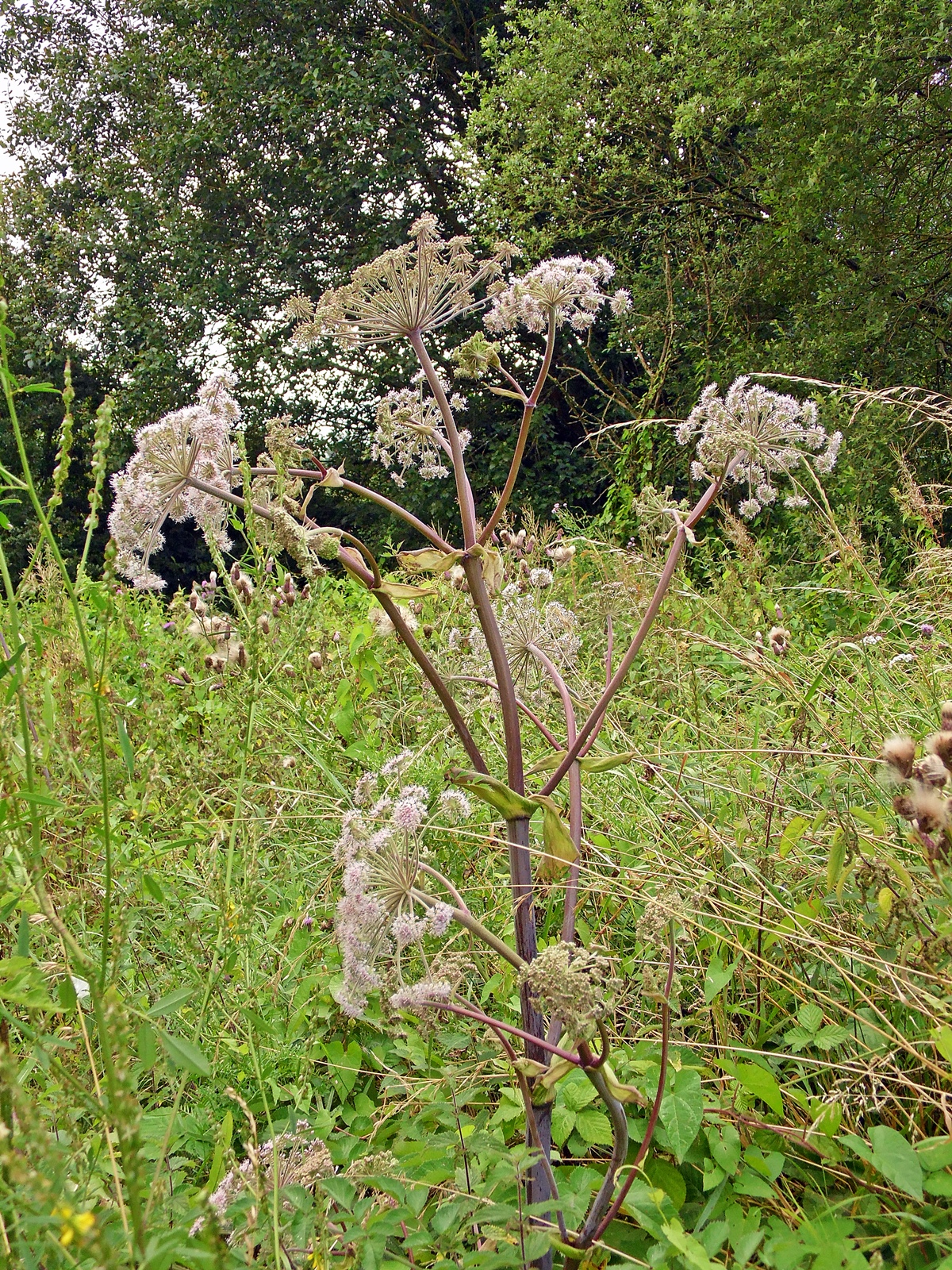
A good indication that summer is coming to an end is the emergence of Angelica flowers. Also tall and stately, they are too are a great favourite with bees. Their umbels of creamy white flowers are always covered with insects eagre to feed up on the nectar within.
Around the lakes of Straw's Bridge, another favourite of the bees is also in full bloom right now. Water Mint is very common growing around the margins of the lakes and is always frequented by bees, hoverflies and it seems, any number of other flying creatures. The flowers are quite beautiful too, especially when seen close up!
Welcome to my blog. Don't expect anything too high-tech or flashy, this is simply a 'diary' to share some of my photos, thoughts and observations - with a particular bias towards the natural world and the countryside around my home.
Monday, 22 August 2016
Tuesday, 16 August 2016
Chicken
This morning, Malcolm and I were joined on our walk by the ever lovely Jayne. As we strolled through the woods which surround Mapperley Reservoir, our attention was caught by a large fungus, growing on a dead tree stump.
Among the green of the woodland, this bright orange and yellow growth looked like scrambled egg or as Malcolm observed, melted wax. Whatever it was, it was new to us, so a search on line was needed to identify it.
After a short internet search, it turns out be called Laetiporus sulphureus or Chicken-of-the-Woods - less commonly, Sulphur Shelf. A Polypore fungus, it has no stem or cap like many fungi, but is considered to be fairly common in the UK, USA and most of Europe.
Edible when young - as this specimen is - it is supposed to taste of chicken (hence the name) but needs to be cooked and only eaten if a clear liquid can be extracted from it. It is also popular with various deer species.
So, a nice walk with good company this morning and a new 'tick' for the life list too. Not bad for one day!
Among the green of the woodland, this bright orange and yellow growth looked like scrambled egg or as Malcolm observed, melted wax. Whatever it was, it was new to us, so a search on line was needed to identify it.
After a short internet search, it turns out be called Laetiporus sulphureus or Chicken-of-the-Woods - less commonly, Sulphur Shelf. A Polypore fungus, it has no stem or cap like many fungi, but is considered to be fairly common in the UK, USA and most of Europe.
Edible when young - as this specimen is - it is supposed to taste of chicken (hence the name) but needs to be cooked and only eaten if a clear liquid can be extracted from it. It is also popular with various deer species.
So, a nice walk with good company this morning and a new 'tick' for the life list too. Not bad for one day!
Friday, 12 August 2016
Farmland Views
Walking around Shipley Park at this time of year, you are accompanied by the sweet smell not only of the hedgerow flowers, but also the newly mown hay. On the wildlife trust's fields, the cropped grasses are being cropped ever closer by the sheep which are taking advantage of the fresh shoots.
This mixed flock were all spread out across the fields the other day instead of flocking tightly together as they usually do.
Some had given up on the short grass and were taking advantage of the un-cropped grasses at the filed margins. Here, the grass was tall enough to almost hide the sheep.
The views across Shipley Park are quite glorious in the sunshine. From beneath the trees on Shipley Hill, we looked out across the lake in the direction of Nottingham.
It is difficult to imagine as you stand in this spot, that we are sandwiched between two cities with a combined population of over half a million!
This mixed flock were all spread out across the fields the other day instead of flocking tightly together as they usually do.
Some had given up on the short grass and were taking advantage of the un-cropped grasses at the filed margins. Here, the grass was tall enough to almost hide the sheep.
The views across Shipley Park are quite glorious in the sunshine. From beneath the trees on Shipley Hill, we looked out across the lake in the direction of Nottingham.
It is difficult to imagine as you stand in this spot, that we are sandwiched between two cities with a combined population of over half a million!
Wednesday, 10 August 2016
Late Summer Flowers
A sunny morning today found Malcolm and I taking our walk along the trail to Mapperley Village. The paths are lined by a plethora of late summer flowers of varying size, shape and colour. among the smallest are the Common Centaury (Centaurium erythraea). The tiny pink flowers showing up in contrast to the yellow of Perforate st. John's-Wort and Birdsfoot Trefoil.
Growing tall among these plants, the large flowers of Evening Primrose (Oenothera biennis) are a paler yellow and a naturalised species brought o the UK in the 1600's.
In the damper areas and beside the reservoirs and waterways, the pink, feathery flowers of the Hemp Agrimony (Eupatorium cannabinum) are always a good sign that summer is coming to an end. A strange-looking flower, but very popular with the bees and hoverflies.
The warm sunshine brings out the scent of another late summer favourite. Walking along by the old Nutbrook Canal, the frothy flower heads of Meadowsweet (Filipendula ulmaria) fill the air with a heady perfume which is why they were once used as a 'strewing herb.'
The flowers would be picked and sprinkled among the rushes on the floors of houses to fragrance the air. A sort of Medieval 'Shake n Vac.'
Growing tall among these plants, the large flowers of Evening Primrose (Oenothera biennis) are a paler yellow and a naturalised species brought o the UK in the 1600's.
In the damper areas and beside the reservoirs and waterways, the pink, feathery flowers of the Hemp Agrimony (Eupatorium cannabinum) are always a good sign that summer is coming to an end. A strange-looking flower, but very popular with the bees and hoverflies.
The warm sunshine brings out the scent of another late summer favourite. Walking along by the old Nutbrook Canal, the frothy flower heads of Meadowsweet (Filipendula ulmaria) fill the air with a heady perfume which is why they were once used as a 'strewing herb.'
The flowers would be picked and sprinkled among the rushes on the floors of houses to fragrance the air. A sort of Medieval 'Shake n Vac.'
Tuesday, 9 August 2016
Some Gall
As always at this time of year, the trees and hedgerows are beginning to show signs of attack, not just from delinquent children with nothing better to do than to break off branches and pull up wild flowers. The attack I refer to is from much smaller assailants like mites, flies and gall wasps. Oak trees are always among the worst affected - and infected. The results can be quite attractive as in these small Cherry Galls.
These galls are produced on the underside of oak leaves by a small wasp called Cynips quercusfolii. The wasp lays its eggs in dormant oak leaf buds and the resulting wasp larva causes a reaction in the leaf making the tree produce the 'cherry' within which, the larva grows before maturing in the autumn when the leaf drops to the ground.
For now, they just look rather attractive on the leaves.
These galls are produced on the underside of oak leaves by a small wasp called Cynips quercusfolii. The wasp lays its eggs in dormant oak leaf buds and the resulting wasp larva causes a reaction in the leaf making the tree produce the 'cherry' within which, the larva grows before maturing in the autumn when the leaf drops to the ground.
For now, they just look rather attractive on the leaves.
Wednesday, 3 August 2016
Arion agg.
On our walk this morning, we were struck by the number of very large slugs which were sliming their way across the paths. As ever, the biggest we saw were members of what is called,an aggregate species called Arion ater. Often called Black Slugs, they actually come in a range of colours including - as well as black - red, brown and creamy-white. This one was a particularly fine example of the red form.
The foot fringe (rather like the skirt around a small hovercraft) is striped vertically, red and black. At the front end, the optical and sensory tentacles had a bluish tinge to them and this one was displaying a large mantle (the saddle-like, oval organ on it's back.)
Black Slugs, (Arion ater agg.) is native to the UK but it is extremely difficult to distinguish from the introduced species called the Red Slug (Arion rufus.) For this reason, they are usually lumped together in the same aggregate.
Moving on to more 'cuddly' things, we also saw a family of newly-hatched Mallard ducklings as we walked past Osborne's Pond.
A very proud mother was shepherding her brood of eight youngsters across the water looking very pleased with what is probably her second brood of the year. They were certainly more fluffy and conventionally attractive than the slugs!
The foot fringe (rather like the skirt around a small hovercraft) is striped vertically, red and black. At the front end, the optical and sensory tentacles had a bluish tinge to them and this one was displaying a large mantle (the saddle-like, oval organ on it's back.)
Black Slugs, (Arion ater agg.) is native to the UK but it is extremely difficult to distinguish from the introduced species called the Red Slug (Arion rufus.) For this reason, they are usually lumped together in the same aggregate.
Moving on to more 'cuddly' things, we also saw a family of newly-hatched Mallard ducklings as we walked past Osborne's Pond.
A very proud mother was shepherding her brood of eight youngsters across the water looking very pleased with what is probably her second brood of the year. They were certainly more fluffy and conventionally attractive than the slugs!
Monday, 1 August 2016
Round the Park
August already! The summer is slipping by and things are still full of colour on Shipley Park. Much of the colour is not coming from flowers, but from the ripening seeds of millions of grasses.
Seas of russet colours sway in the breeze and wait for the mowers to come and put an end to their growing year. These meadow grasses were to be found on the way to Cinder Hill a few days ago.
As always, it pays to get down to 'grass level' and get an insects eye view, particularly when the delicate seed heads of the grasses can be seen against a bright sky.
Occasionally, poking up above the grasses, tall spikes of Purple Loosestrife (Lythrum salicaria) thrust up to add their colour to the palate.
Elsewhere, the Derbyshire Wildlife Trust have created a wildlife garden behind the large barn which they use as the centre of operations for the area. In this garden, two raised ponds provide a home for numerous water snails and the larvae of many crawling and flying things. Among all this fauna, a small, but rather beautiful White Water Lily was making its presence felt last Wednesday.
White Water Lilies (Nymphaea alba) have the largest flower of any wild flower. It is to be found growing all over Europe as far north as Scandinavia, from where it might well originate. This particular flower was covered with small flies as indeed seemed to be the whole garden!
Seas of russet colours sway in the breeze and wait for the mowers to come and put an end to their growing year. These meadow grasses were to be found on the way to Cinder Hill a few days ago.
As always, it pays to get down to 'grass level' and get an insects eye view, particularly when the delicate seed heads of the grasses can be seen against a bright sky.
Occasionally, poking up above the grasses, tall spikes of Purple Loosestrife (Lythrum salicaria) thrust up to add their colour to the palate.
Elsewhere, the Derbyshire Wildlife Trust have created a wildlife garden behind the large barn which they use as the centre of operations for the area. In this garden, two raised ponds provide a home for numerous water snails and the larvae of many crawling and flying things. Among all this fauna, a small, but rather beautiful White Water Lily was making its presence felt last Wednesday.
White Water Lilies (Nymphaea alba) have the largest flower of any wild flower. It is to be found growing all over Europe as far north as Scandinavia, from where it might well originate. This particular flower was covered with small flies as indeed seemed to be the whole garden!
Subscribe to:
Posts (Atom)